


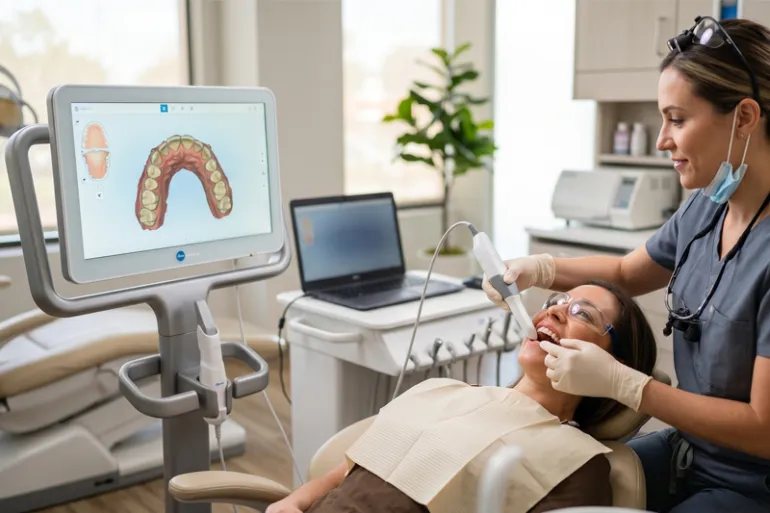
The way veneers are designed and delivered has changed dramatically over the last decade. What was once a heavily manual, impression-based process is now increasingly digital, precise, and patient-friendly. At the center of this transformation is the intraoral scanner, a technology that has redefined how custom veneers are planned, designed, and manufactured.
Today, intraoral scanning is not just a convenience tool. It is a foundational step in achieving highly aesthetic, natural-looking, and long-lasting veneer results.
What Are Intraoral Scanners?
An intraoral scanner is a handheld digital device used by dentists to create a highly detailed 3D model of a patient’s teeth and gums. Instead of traditional impression materials, the scanner captures thousands of images per second and stitches them into a precise digital model.
This model becomes the foundation for designing restorations such as dental crowns, bridges, and most importantly veneers. The result is a fast, clean, and extremely accurate representation of the patient’s mouth.
Why Veneers Require Extreme Precision
 Veneers are thin shells placed on the front surface of teeth to improve their appearance. They are used to correct
- Discoloration
- Gaps between teeth
- Minor misalignment
- Chips or worn enamel
- Irregular tooth shape or size
Because veneers are highly visible and often only 0.3–0.7 mm thick, even the smallest error in measurement can affect fit, symmetry, bite alignment and final aesthetics.
This is why precision in the planning stage is critical and where intraoral scanners play a transformative role.
From Traditional Impressions to Digital Accuracy
In the traditional approach, dentists used impression trays filled with silicone or alginate material. While effective, these methods had several limitations:
• Discomfort for patients (gag reflex, messiness, unpleasant taste of the impression material)
• Risk of distortion during removal
• Longer procedure time, as impressions may take several minutes to set
• Storage and shipping issues
• Re-impressions if errors occurred, increasing treatment time further
In contrast, intraoral scanners eliminate many of these challenges. Digital impressions provide real-time visualization, higher accuracy, instant error detection, and easy file sharing with labs. Scans can often be completed within one to two minutes, and any minor inaccuracies can be corrected instantly by rescanning only the affected area in seconds. This improves both patient experience and clinical outcomes significantly.
How Intraoral Scanners Improve Veneer Design
 1. Ultra-Precise Digital Mapping
Intraoral scanners capture the exact shape, spacing, and surface texture of teeth. This allows dental professionals to design veneers that fit seamlessly without gaps or over-contouring. Even microscopic details such as enamel curvature and gum contours are recorded, which is essential for achieving natural-looking results.
2. Better Smile Design Planning
Modern veneer treatments are not just about fixing teeth they are about designing smiles.
Digital scanning allows clinicians to simulate final veneer outcomes, adjust tooth proportions digitally, evaluate symmetry before treatment begins, plan multiple aesthetic options. At our advanced dental practices digital smile design workflows often integrate intraoral scans with facial analysis to create highly personalized smile transformations.
3. Improved Communication With Dental Labs
Once a scan is completed, the digital file is sent directly to a dental laboratory or in-house CAD/CAM system. This eliminates physical transport delays, risk of impression damage and miscommunication between clinic and lab. Technicians can rotate, zoom, and analyze the 3D model in detail, ensuring that veneers are fabricated exactly as intended.
4. Faster Turnaround Time
Traditional impressions often require multiple steps and shipping time. Intraoral scanning significantly reduces this timeline. The workflow includes scan patient’s teeth, design veneers digitally (CAD software), fabricate using milling or 3D printing and final placement. This streamlined process can shorten veneer treatment time from weeks to just a few days in some cases.
5. Higher Patient Comfort and Experience
Patients often find traditional impressions uncomfortable. Intraoral scanners eliminate this entirely.
Benefits include no gag reflex, no unpleasant impression materials, shorter chair time and immediate visual feedback. Patients can even see a digital preview of their teeth, helping them understand and visualize their future smile.
Integration With CAD/CAM Technology
Intraoral scanners do not work alone they are part of a larger digital ecosystem called CAD/CAM (Computer-Aided Design and Computer-Aided Manufacturing).
Once the scan is completed
- CAD software is used to design veneers digitally
- Adjustments are made for shape, shade, and alignment
- CAM systems mill or 3D print the veneers from ceramic or composite materials
This integration ensures a seamless transition from scan to final restoration with minimal human error.
Role in Achieving Natural-Looking Veneers
One of the biggest challenges in cosmetic dentistry is avoiding the “fake smile” look. Intraoral scanners help solve this problem by allowing ultra-detailed customization.
Dentists can precisely control
- Tooth length and width ratios
- Gum line harmony
- Midline alignment
- Light reflection and surface texture
This level of control helps create veneers that blend naturally with surrounding teeth rather than appearing artificial or bulky.
Reducing Errors and Rework
Even small inaccuracies in traditional impressions can lead to
- Ill-fitting veneers
- Bite discomfort
- Need for adjustments or remakes
Intraoral scanners significantly reduce these risks by capturing accurate digital data at the first appointment. If any issue is detected, rescanning a small area is quick and easy no need to redo the entire impression.
This improves clinical efficiency and reduces treatment costs over time.
Digital Records for Long-Term Care
Another advantage of intraoral scanning is digital record keeping. Once a scan is stored, it becomes part of the patient’s permanent digital dental file.
This allows easy comparison over time, monitoring of veneer wear, planning future treatments and faster repairs or replacements if needed. It creates continuity in cosmetic dental care that was not possible with traditional models.
If you are considering custom veneers or want to explore a fully digital smile makeover, our team of specialist cosmetic dentists at Dr Joy Dental Clinic is here to guide you. Contact us today at 80037569 to book an appointment with our cosmetic dentists and take the first step toward your perfect smile.


