


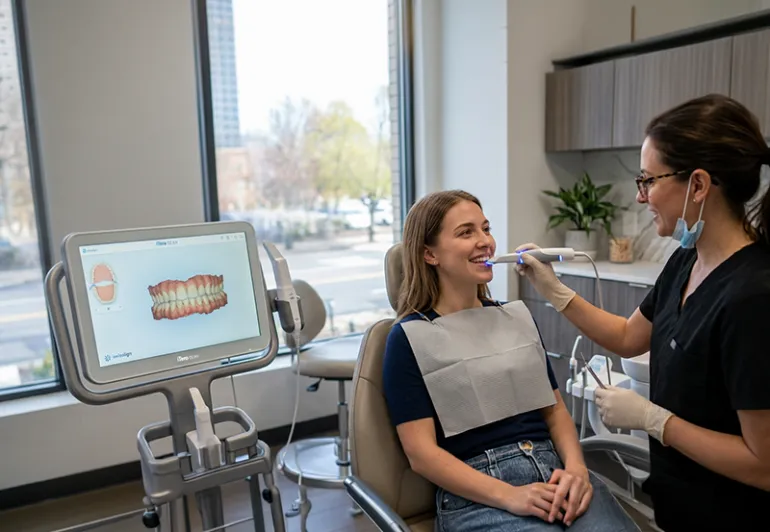
If you have ever had a traditional dental impression, you probably remember the experience. A tray filled with thick impression material was placed over your teeth and had to stay there until it set. For some people, this could feel uncomfortable and even trigger a gag reflex.
Today, starting your Invisalign journey can be much easier. Digital intraoral scanners, such as the iTero scanner, allow your dentist or orthodontist to create a detailed 3D image of your teeth without traditional putty impressions.
The process is quick, comfortable and gives your dental team the detailed information they need to plan your Invisalign treatment.
Why Traditional Dental Molds Can Be Uncomfortable
 Traditional dental impressions have been used for many years to create models of a patient’s teeth. The dentist places impression material into a tray and positions it over the upper or lower teeth. You then need to wait for the material to set before the tray can be removed.
While effective, the experience isn’t always pleasant. Patients may experience:
- An uncomfortable feeling from the impression tray
- An unpleasant taste or texture
- Difficulty swallowing while the impression sets
- A sensitive gag reflex
- Discomfort when the tray is removed
Physical impressions can also sometimes develop small inaccuracies because of movement, air bubbles or changes in the impression material. If an impression isn’t clear enough, it may need to be taken again. A physical impression typically takes at least 2–3 minutes just to set, whereas a digital scan can often be completed within a minute when performed by a trained professional.
With Invisalign, accurate information about the position and shape of your teeth is especially important because your aligners are custom-made according to your treatment plan.
How Digital Scanning Works
Digital scanning replaces the traditional impression tray with a small handheld scanning device. Your dentist or orthodontist gently moves the scanner around your teeth while it captures detailed images of your mouth.
These images are combined to create a 3D digital model of your teeth and bite.
During a typical digital scan:
The scanner moves around your teeth: Your upper teeth, lower teeth and bite are carefully scanned.
There’s no messy impression material: You don’t need to sit with a tray full of putty in your mouth.
You can take a break if needed: If you feel uncomfortable, the scanning process can usually be paused and resumed.
Specific areas can be rescanned: If more detail is needed, your dentist can simply scan that area again rather than repeating the entire process.
You can see your teeth in 3D: The digital model appears on the screen as the scan is completed.
The scanning process usually takes only a few minutes, although the exact time can vary depending on your individual case.
From Your Digital Scan to Your Invisalign Treatment Plan
Once your digital scan is completed, the information can be used to help develop your Invisalign treatment plan.
Because the scan is digital, there is no physical impression that needs to be packaged and transported to a laboratory. Your dental team can work with the digital model to assess your teeth, bite and orthodontic needs.
The scan can help your dentist or orthodontist:
- Assess the current position of your teeth
- Identify crowding, spacing and bite concerns
- Plan how individual teeth may need to move
- Develop the different stages of your Invisalign treatment
- Explain your proposed treatment more clearly
Depending on your case, Invisalign’s digital treatment-planning tools may also allow your dentist to show you a simulation of how your teeth are expected to move during treatment.
This preview is a treatment-planning tool rather than a guarantee of the exact final result. However, it can make it easier to understand the proposed changes and discuss your treatment goals before getting started.
Why Accurate Digital Scans Matter for Invisalign
Invisalign treatment uses a series of custom-made clear aligners. Each set is designed to guide your teeth gradually according to the treatment plan created for you.
That means having an accurate starting model of your teeth is important.
Digital scanners capture detailed information about the surfaces of your teeth, gumline and bite. Your dentist can also review the scan immediately and rescan areas where additional detail is required.
This can be particularly useful when capturing areas such as:
- Crowded or overlapping teeth
- Back teeth that may be more difficult to reach
- Areas around the gumline
- Your upper and lower bite relationship
The digital model then becomes an important part of planning and manufacturing your Invisalign aligners.
A More Comfortable Start to Orthodontic Treatment
For many patients, one of the biggest advantages of digital scanning is simply comfort.
There’s no tray filled with impression material pressing against your teeth and palate, and you don’t have to wait for putty to harden in your mouth.
Instead, digital scanning can provide:
- A cleaner experience
- Less discomfort
- No impression-material taste or texture
- A reduced chance of triggering a gag reflex
- Easy rescanning when additional information is required
- An interactive 3D view of your teeth
Digital scanning may also be useful later in your Invisalign journey if your dentist needs updated information about your teeth or treatment progress.
What to Expect When Starting Your Invisalign Journey
 Every Invisalign case is different, but your journey will generally begin with an orthodontic assessment.
Your dentist or orthodontist will examine your teeth, bite and overall oral health to determine whether Invisalign may be suitable for you.
If you proceed with treatment, the process may include:
- Initial consultation: Discuss your concerns, smile goals and treatment options.
- Digital scan: A 3D model of your teeth and bite is created.
- Treatment planning: Your dentist or orthodontist plans the proposed movements of your teeth.
- Digital preview: Where appropriate, you may be shown a simulation of your proposed tooth movements.
- Custom aligners: Your Invisalign aligners are manufactured according to your approved treatment plan.
- Progress appointments: Your dental team monitors your teeth throughout treatment and makes adjustments when required.
From Putty to Digital Precision
Moving from traditional impressions to digital scanning may sound like a small change, but it can make the beginning of orthodontic treatment much more comfortable and convenient.
For Invisalign patients, digital scanning provides a detailed 3D model that helps your dentist or orthodontist plan your treatment while also giving you a clearer understanding of your teeth and proposed treatment journey.
Most importantly, you can start the process without the messy putty impressions many patients remember from traditional orthodontic treatment.
Ready to Explore Invisalign?
If you’re considering Invisalign, contact us today at 80037569 to book a consultation with our specialist orthodontists at Dr Joy Dental Clinic. Our team can assess your teeth and bite, discuss whether Invisalign is suitable for you, and explain how digital scanning can be used to plan your personalised orthodontic treatment.


