


Early Airway Assessments
Advanced Dental Technology
Dedicated Myofunctional Therapist
Snoring Isn’t Always “Just Snoring”
Many parents think a child’s snoring is cute, or simply a phase. Often it is. But regular snoring, breathing through the mouth, restless nights and waking up tired can be signs that your child isn’t breathing as easily as they should during sleep.
Children do almost all of their growing — and a lot of their learning — while they sleep. That’s why it’s worth paying attention when sleep doesn’t look peaceful.
As pediatric dentists, we see your child’s mouth, jaws and bite at every check-up, which puts us in a unique position to spot early signs that may be linked to breathing problems. When we find them, we guide you on what to do next — whether that’s simple monitoring, orthodontic care, or a referral to the right medical specialist.
Why Parents Choose Dr. Joy Dental Clinic
- Specialist pediatric dentists who focus entirely on children's dental health and development
- 21 years of dental care for Dubai families
- A dedicated myofunctional therapist who trains children one-to-one in breathing, tongue and lip exercises, at our Beach Road and Jumeirah Golf Estates clinics
- A whole-child approach — looking beyond teeth to breathing, sleep and growth
- Personalized developmental assessments tailored to your child's age and needs
- Teamwork with orthodontists, pediatricians and ENT specialists for joined-up care
- Advanced dental technology for comfortable, accurate assessments
- Sedation options for anxious or nervous children
- Child-friendly clinics designed to make visits fun, not frightening
- 14 convenient locations across Dubai
What Is Pediatric Airway Dentistry?
Pediatric airway dentistry looks at how your child’s teeth, jaws, palate (roof of the mouth) and tongue are developing — and how that development can affect breathing, especially during sleep.
A narrow upper jaw, a small or set-back lower jaw, a low-resting tongue or long-term mouth breathing can all be connected to how well air moves through the nose and throat. Spotting these early, while your child is still growing, gives you more options.
Is My Child's Snoring Normal? Signs to Watch For
Occasional snoring during a cold is common. Studies suggest that around 1 in 10 children snore regularly, and a smaller number (about 1–5%) have obstructive sleep apnea. Consider booking an assessment if your child often shows any of the signs below.
At night
- Snoring that is loud or happens most nights — not just when they have a cold
- Mouth breathing while asleep, or sleeping with the mouth open
- Pauses in breathing, gasping or choking sounds during sleep
- Restless sleep — tossing and turning, frequent waking, or unusual sleeping positions (such as the head tilted far back)
- Teeth grinding at night
- Night sweats or bedwetting after they had previously been dry at night
During the day
- Tiredness, difficulty waking up in the morning, or morning headaches
- Irritability, hyperactivity or trouble concentrating at school — poor sleep in children can look a lot like attention problems
- Mouth breathing during the day, or lips that are often apart at rest
- Dark circles under the eyes or a constantly blocked nose
In the mouth and face
- A narrow upper jaw or high, narrow palate
- Crowded teeth or a crossbite (upper teeth sitting inside the lower teeth)
- A small or set-back lower jaw
- Tongue-tie, tongue thrusting, or long-term thumb sucking or dummy use
Why an Early Assessment Matters
Children's jaws are still growing, which makes childhood the best time to guide development. Some problems that are simple to address at age 7 may be more complex to correct in the teenage years.
Better breathing at night can also mean better sleep — and well-rested children tend to have more energy, better focus and happier days. You don't need a referral to book an assessment; if something about your child's sleep doesn't feel right, it's worth asking.
Your Child's Airway Assessment: What to Expect
Our assessment is gentle, relaxed and designed with children in mind. Here's how it works:
We listen.
We ask about snoring, mouth breathing, sleep quality, daytime energy and behavior, and your child's medical history. Videos of your child sleeping are very helpful — feel free to bring them.
We examine.
Our pediatric dentist looks at the teeth, bite, palate, jaw growth, tongue movement and position, lips and breathing habits.
We explain.
We share what we found in simple terms and recommend the right next step — which may be monitoring, an orthodontic evaluation, or a referral to a pediatrician, ENT or sleep specialist.
We plan together.
If dental or orthodontic care can help, we create a personalized plan based on your child's age, growth stage and needs.
Airway Treatment Options for Children
Every child is different, and not every child needs treatment. When care is recommended, it may include one or more of the following. Your dentist will explain which options suit your child, and why.
Early Interceptive Orthodontics
Early orthodontic treatment, usually between ages 6 and 10, uses your child's natural growth to guide the jaws and make room for adult teeth. Orthodontic organizations recommend a first orthodontic check by age 7.
Palatal Expansion (Palate Expander for Kids)
For children with a narrow upper jaw or crossbite, a palate expander gently widens the upper jaw over a few weeks. It works best while the jaw is still growing. It is an orthodontic treatment — it may help nasal breathing in some children, but it is not a guaranteed treatment for sleep apnea.
Crossbite Correction
A crossbite happens when upper teeth sit inside the lower teeth. Correcting it early can support balanced jaw growth and a healthier bite.
Functional Orthodontic Appliances
Removable or fixed appliances that guide the growth and position of the jaws. For some growing children with a small or set-back lower jaw, an appliance that encourages the lower jaw forward (a mandibular advancement appliance) may be considered.
Myofunctional Therapy
A program of simple exercises to train the tongue, lips and facial muscles, led by our dedicated myofunctional therapist. It encourages nasal breathing, correct tongue posture and lips that rest together. Learn more in the section below.
Tongue-Tie Assessment and Release
A tight band of tissue under the tongue (tongue-tie) can stop the tongue resting in the right place. We assess how well the tongue moves and functions, and in selected cases a tongue-tie release may be recommended, usually alongside myofunctional exercises.
Oral Habit Support
Gentle, child-friendly support to help children stop habits such as thumb sucking, prolonged dummy use or tongue thrusting that can affect how the jaws and teeth develop.
Follow-Up and Sleep Reassessment
We monitor progress through regular follow-ups, in person or by video call where appropriate. After treatment, we can coordinate with your child's doctor if a follow-up sleep assessment is recommended.
Why Does My Child Breathe Through Their Mouth? How Jaws, Tongue and Breathing Connect
Jaw and palate development
The roof of the mouth is also the floor of the nose. A narrow upper jaw can mean less room for the tongue and, in some children, a narrower nasal passage. A small or set-back lower jaw can also reduce space at the back of the throat.
Tongue posture and oral habits
Ideally, the tongue rests against the roof of the mouth, gently guiding the upper jaw to grow wide. When the tongue rests low — because of mouth breathing, a tongue-tie, tongue thrusting or prolonged thumb sucking — the jaws and teeth may develop differently.
Blocked nose, tonsils and adenoids
Allergies, a constantly blocked nose and enlarged tonsils or adenoids are among the most common reasons children breathe through their mouths and snore. These are medical issues, so we refer children to a pediatrician or ENT specialist when we suspect them.
Sleep-Related Breathing Problems in Children
Sleep-disordered breathing is the umbrella term doctors use for breathing problems during sleep. It ranges from simple snoring to obstructive sleep apnea. Here is what the most common terms mean, in plain language:
Primary snoring
Regular snoring without breathing pauses or drops in oxygen. Still worth checking if it happens most nights.
Upper Airway Resistance Syndrome (UARS)
The airway narrows during sleep, so your child works harder to breathe. They may not stop breathing, but sleep is disturbed — often leading to daytime tiredness or behavior changes.
Obstructive Sleep Apnea (OSA)
The airway partly or fully closes again and again during sleep, causing pauses in breathing, gasping and broken sleep. It is diagnosed by a doctor, usually with a sleep study.
Enlarged tonsils and adenoids
The most common cause of sleep apnea in young children. Assessed and treated by an ENT specialist.
Nasal obstruction
A blocked nose from allergies, a deviated septum or other causes, which pushes a child to breathe through the mouth.
Jaw and facial development (craniofacial) factors
A narrow upper jaw or small lower jaw can reduce airway space. This is where pediatric dentists and orthodontists can help most.
Some breathing problems — such as low oxygen levels during sleep (sleep-related oxygen desaturation or hypoventilation), or breathing issues linked to neuromuscular conditions — can only be identified through medical testing. If we see warning signs, we'll help you connect with the right specialist.
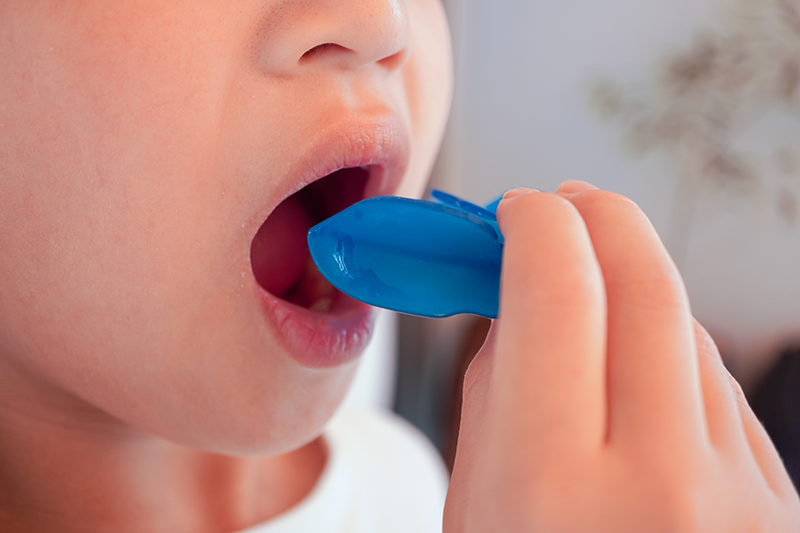
What is Myofunctional Therapy?
Myofunctional therapy is like physiotherapy for the mouth and face. Through a series of gentle exercises, children learn to:
- Breathe through the nose instead of the mouth, during the day and at night
- Rest the tongue in the right place — against the roof of the mouth
- Keep the lips together comfortably at rest
- Swallow and chew correctly, without pushing the tongue against the teeth
How the Program Works
Myofunctional assessment
Our therapist checks how your child breathes, swallows, chews and rests their tongue and lips.
A personalized exercise plan
Exercises are chosen for your child's age and needs, and explained in a way children enjoy — think games and challenges, not homework.
One-to-one sessions with the therapist
Regular sessions at our Beach Road or Jumeirah Golf Estates clinic to learn new exercises, check technique and keep motivation high. Some reviews can be done by video call.
Short daily practice at home
Just a few minutes a day, with app-based exercises and progress charts where suitable. Parents get clear guidance on how to help.
Progress reviews
Our therapist and dentist review progress together and adjust the plan as your child improves.
Which Children Can Benefit?
Our myofunctional therapist may work with your child if they:
- Breathe through their mouth or sleep with their mouth open
- Have a low tongue posture or a tongue thrust when swallowing
- Find it hard to keep their lips together at rest
- Have habits such as thumb sucking, prolonged dummy use or nail biting
- Are having, or have had, orthodontic treatment or a palate expander — exercises help support stable results
- Have had a tongue-tie release and need to learn to use their tongue's new range of movement
Myofunctional Therapy for Kids with Our Dedicated Myofunctional Therapist
Healthy breathing isn’t only about the shape of the jaws — it’s also about how the muscles of the tongue, lips and face work. That’s why Dr. Joy Dental Clinic has a dedicated myofunctional therapist on our team, based at our Beach Road and Jumeirah Golf Estates clinics, who works one-to-one with children to retrain these muscles through simple, fun exercises.
Our therapist works hand in hand with our pediatric dentists and orthodontists, so your child’s exercises are part of one joined-up plan rather than a separate treatment.
How it helps your child
With regular practice, myofunctional therapy can help children build healthy habits that support better breathing, normal jaw development and a stable bite. Many parents notice their child keeping their mouth closed more often and breathing more easily through the nose.
Myofunctional therapy works best as part of a wider plan. It does not replace medical treatment for enlarged tonsils, adenoids or sleep apnea, and results depend on each child and on consistent practice at home.
What Our Patients Have to Say

We visited Dr. Joy Dental Clinic because we were concerned about our child's mouth breathing and snoring. The dentist took the time to explain how breathing habits, jaw development, and sleep can be connected. The assessment was thorough, and we felt comfortable asking questions. Really appreciated the attention and care.
Very good experience with the Dr Joy Dental Clinic. The dentist and myofunctional therapist were both very supportive and took time to answer our questions. The clinic is child-friendly, and the overall experience was smooth.
We started myofunctional therapy for our child after noticing some mouth breathing habits. The therapist explained the exercises in a simple way and made each session comfortable and engaging. It's been a positive experience for our family.
Concerned About Your Child's Snoring or Sleep? We're Here to Help.
Book an airway assessment with one of our pediatric dentists. We'll take the time to understand your child, explain what we find in plain language, and guide you on the next steps — with no pressure and no confusing jargon.
Frequently Asked Questions
OUR TREATMENT LOCATIONS
Premium Dental Clinics in Dubai
-
ساعات العيادة
الإثنين - الأحد (7 أيام في الأسبوع)
09:00 AM - 08:00 PM -
ساعات العيادة
الإثنين - الأحد (7 أيام في الأسبوع)
9 صباحًا - 8 مساءً -
ساعات العيادة
من الاثنين وحتى الأحد (7 أيام في الأسبوع)
9am - 9pm -
ساعات العيادة
الأحد – السبت
9am - 9pm -
ساعات العيادة
الإثنين - الأحد (7 أيام في الأسبوع)
9 صباحًا - 9 مساءً -
ساعات العيادة
الأصل: من الإثنين إلى الأحد (7 أيام في الأسبوع)
9am - 8pm الجمعة
مغلق -
ساعات العيادة
من الإثنين إلى الأحد (7 أيام في الأسبوع)
11 صباحًا - 8 مساءً -
ساعات العيادة
الإثنين - الأحد (7 أيام في الأسبوع)
9:00 AM - 10:00 PM -
ساعات العيادة
الاثنين - الجمعة والأحد
9am - 9pm السبت
8am - 9pm -
ساعات العيادة
الإثنين - الأحد (7 أيام في الأسبوع)
9 صباحًا - 9 مساءً -
ساعات العيادة
الثلاثاء، السبت: من الساعة 11:00 صباحًا إلى الساعة 9:00 مساءً
الأحد: من الساعة 10:00 صباحًا إلى الساعة 7:00 مساءً الاثنين والجمعة: من الساعة 12:00 ظهرًا إلى الساعة 9:00 مساءً، الخميس: من الساعة 10:00 صباحًا إلى الساعة 9:00 مساءً.
الأربعاء: من الساعة 9:00 صباحًا إلى الساعة 9:00 مساءً -
ساعات العيادة
الاثنين - الأحد: من 9 صباحًا إلى 9 مساءً
-
ساعات العيادة
السبت – الخميس
8 صباحًا - 8 مساءً الجمعة
11 صباحًا - 8 مساءً

Book Your Appointment
مركز أم سقيم لطب أسنان الأطفال وتقويم الأسنان
ساعات العيادة
الإثنين - الأحد (7 أيام في الأسبوع)

